
Haymaker Daily
On precisely defining a soft-landing

Hello, Subscribers:
Consumer sentiment, as measured by the University of Michigan’s index, has just registered a preliminary November reading of 50.3 (previously 53.6, also per the index), or a hair above the all-time low set in June 2022. To put that in context, today’s consumer confidence is lower than during the depths of the COVID panic, the 2008 financial crisis, or the 1979-80 stagflation shock. In other words, American households feel worse about economic conditions today than they did when the pandemic brought the global economy to its knees and/or Lehman Brothers collapsed.
This obviously has real-world implications for the equity market, particularly in consumer discretionary, retail, and small-cap names whose earnings are directly tied to consumer demand and sentiment tailwinds. And, it helps explain why the market has struggled to find durable breadth despite easing inflation and an allegedly resilient labor market.
As you can see below, that resilience is definitely debatable.
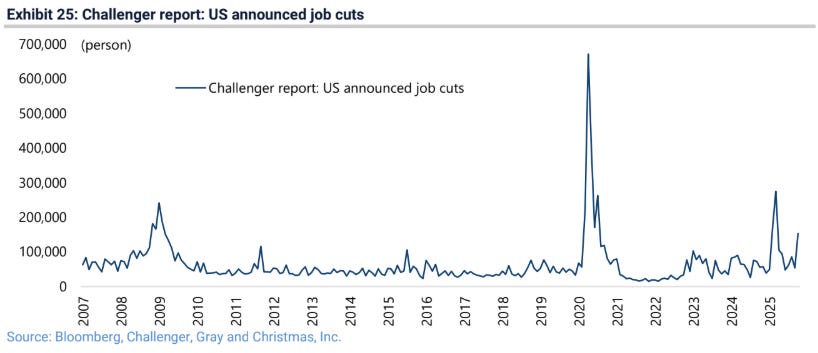
Undoubtedly, this is behind much of the anxiety American households feel today. Further, the fact that this year has seen Challenger’s job loss surveys essentially match what occurred during the Great Recession contradicts the oft-stated view that it is only hiring that is weak. Obviously, there are a plethora of layoffs occurring as headlines like Amazon’s 30,000 labor-force reduction underscores.
Historically, sentiment this depressed is a contrarian bullish signal, but with an asterisk. It’s true that past troughs in the consumer sentiment index have often coincided with strong forward 12-month returns in equities. But those bounces typically occurred in tandem with aggressive monetary easing or clear cyclical turnarounds, neither of which is visible today. Moreover, stocks are almost always bombed-out when consumers are this wary; that’s 180° opposite of today’s equity environment. With the Fed only just beginning to taper QT, and fiscal space constrained by near-record debt issuance, there’s no cavalry coming to juice the cycle.
Instead, persistently low sentiment may point to a long stretch of consumer retrenchment: lower spending, higher savings rates, and a broad-based reluctance to lever up. That likely spells trouble for sectors built on margin expansion and top-line growth assumptions, while favoring more defensive, cash-generative names. This is especially true for those with international revenue exposure, where sentiment dynamics are less dire.
If this is what a soft landing feels like, investors may need to start redefining the word “soft”.
David “The Haymaker” Hay
IMPORTANT DISCLOSURES
This material has been distributed solely for informational and educational purposes only and is not a solicitation or an offer to buy any security or to participate in any trading strategy. All material presented is compiled from sources believed to be reliable, but accuracy, adequacy, or completeness cannot be guaranteed, and David Hay makes no representation as to its accuracy, adequacy, or completeness.
The information herein is based on David Hay’s beliefs, as well as certain assumptions regarding future events based on information available to David Hay on a formal and informal basis as of the date of this publication. The material may include projections or other forward-looking statements regarding future events, targets or expectations. Past performance is no guarantee of future results. There is no guarantee that any opinions, forecasts, projections, risk assumptions, or commentary discussed herein will be realized or that an investment strategy will be successful. Actual experience may not reflect all of these opinions, forecasts, projections, risk assumptions, or commentary.
David Hay shall have no responsibility for: (i) determining that any opinion, forecast, projection, risk assumption, or commentary discussed herein is suitable for any particular reader; (ii) monitoring whether any opinion, forecast, projection, risk assumption, or commentary discussed herein continues to be suitable for any reader; or (iii) tailoring any opinion, forecast, projection, risk assumption, or commentary discussed herein to any particular reader’s investment objectives, guidelines, or restrictions.
David Hay is a passive owner of Evergreen Gavekal (“Evergreen”), a registered investment adviser with the Securities and Exchange Commission. As of 03/31/2025 Mr. Hay has no involvement in the day to day operations of Evergreen, nor is he involved with any investment research, or investment management performed by Evergreen. The information herein reflects the personal views of David Hay as a seasoned investor in the financial markets and any recommendations noted may be materially different than the investment strategies that Evergreen manages on behalf of, or recommends to, its clients.
Different types of investments involve varying degrees of risk, and there can be no assurance that the future performance of any specific investment, investment strategy, or product made reference to directly or indirectly in this material, will be profitable, equal any corresponding indicated performance level(s), or be suitable for your portfolio. Due to rapidly changing market conditions and the complexity of investment decisions, supplemental information and other sources may be required to make informed investment decisions based on an individual’s investment objectives and suitability specifications. All expressions of opinions are subject to change without notice. Investors should seek financial advice regarding the appropriateness of investing in any security or investment strategy discussed in this presentation.
The soft landing scenario is actully favorable for mREITs like TWO. When rates stabilze without a recession, they can maintian high dividend yields while book values recover. TWO's current 10%+ yield looks attractive in this enviroment.
Hard to fathom the American consumer ever pulling back and actually saving. Totally ingrained in the American ethos at this point- instant gratification and living beyond one’s means. However, for the lower-middle class it’s seemingly the only option to survive.