
Friday Haymaker
More from Grant's 'Fin De Siècle' Anthology

Hello, Subscribers!
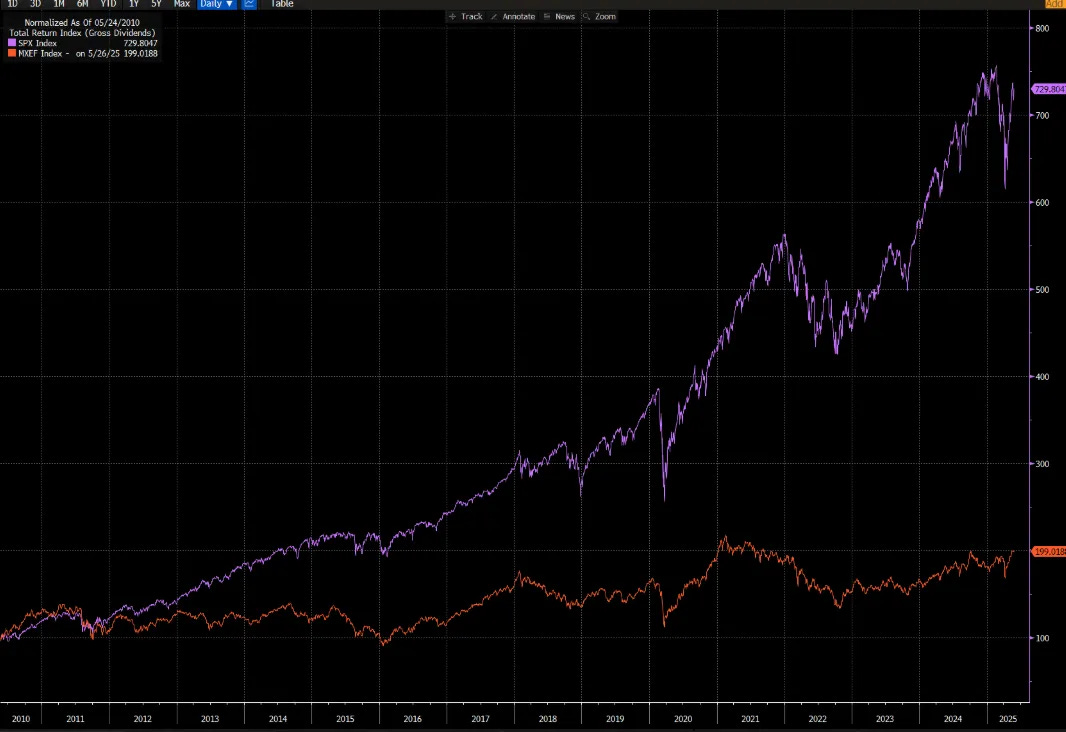
First, a note of correction. In Tuesday’s Making Hay (Almost) Monday edition, we prefaced much of the piece with an analysis of the S&P 500’s performance over the past 15 years, pointing out that it had seen a 7x increase during that time. However, the chart we initially ran to emphasize that point was incorrect/misaligned in its reading. We have since replaced it with a correct version, which you can see below. Our apologies for the error.
Today’s guest entry, republished from Grant Williams’ marvelous Fin De Siècle collection, is a powerhouse of social reflection brought to us by Anthony ‘Tony’ Deden. It was fittingly the closing piece in Fin De Siècle, as its scope is as immense as its diagnosis is well-argued. To condense several of its major points, the way societies work when at their best is very different from the way the Western World’s societies are working (read: failing) now. Institutional trust is subterranean, currencies are manipulated beyond recognition, morality runs a distant second to legal gamesmanship, and a quick buck (even of the inflation-eroded type) matters a lot more than lasting wealth to far too many.
Deden references major Fourth Turning themes (a frequent Haymaker topic), but also draws on the minds of philosophers across the centuries in establishing large-scale context for his argument. The systems of civilization are faltering, possibly in line with the predictable/predicted trends of Howe and Strauss (authors of the bestseller, The Fourth Turning), but also in ways specific to our time and to the peoples who have the most to lose when political/economic stability finally gives way.
As Grant sums it up:
As always, the questions posed by Tony are simple but profound. The answers, however, are far more complex and elusive. Principles such as scarcity, trust, authenticity and consequence form the organic core of a way of life for Tony—the only way he knows—but to others today, they are optional at best and incongruent at worst. But those principles used to constitute far more than one man’s foundation. They were the bedrock upon which our society was built.
Investors are almost certainly wise to ask themselves if the Fourth Turning thesis, updated in Neil Howe’s latest bestselling book The Fourth Turning Is Here, is valid. If so, the related critical question is: Are financial markets even remotely pricing in that potentiality?
Once again, great thanks to Grant for allowing us to run this extraordinary anthology for the benefit of our subscribers. In the year ahead, we believe the main messages contained within it will stand the test of time far better than the constant “don’t worry, be happy” lyrics the chorus of Wall Street perma-bulls is constantly singing.
The Haymaker Team

(Originally published in Grant Williams’ Fin de Siècle, February 2025)
This essay is a distillation of notes and reflections from the past summer—never originally intended for publication. However, in recent weeks, I decided to share it with you. The election of Mr. Trump in the United States, and the immense hope for change that many have placed in him, prompted me to do so. Naturally, we wish him well. However, I believe that the challenges he faces, and those confronting the Western world more broadly, are not just political but civilizational in nature. They stem from deep historical and philosophical shifts that have reshaped governance, economy, and societal values.
For an honourable person entrusted with safeguarding the hard-earned property and savings of others, the task has never been easy. The value of such work is often judged in hindsight, and measured through accounting, yet it demands foresight and sound judgment. In normal times, bridging the gap between these two perspectives requires effort, but it remains possible.
However, we have not lived in normal times for a long while. Seeking meaning, we turn to economists, forecasters, and modern financial soothsayers—only to discover that much of what passes for explanation is, at best, mere speculation. No one seems to have the answers to the pressing questions that haunt us, those endless inquiries that begin with “why.”